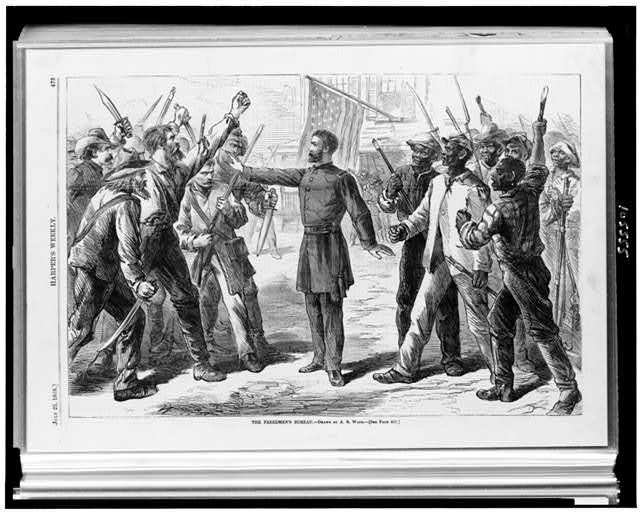
I started looking into Reconstruction as a topic based on the recommendation of my friend, Paul. There were times while I was researching and writing that I was silently cursing his name. Reconstruction is a fascinating topic, but as I said in my article, it’s incredibly dense. It took a lot of work to cover Reconstruction while keeping the article short. I won’t lie; I let out a giant sigh of relief upon completing the article. Don’t worry, I got my revenge on Paul by making him proofread the article.
Reconstruction is such a full topic because it encompasses almost every aspect of American life from 1863 to 1877. In my article, I stated that I limited Reconstruction to the South because that is the heart of the story, but it’s not the only aspect. The North went through tremendous change, and Americans kept moving West. Please consider my article about Jesse James as part of Reconstruction to highlight how much Reconstruction covers. However, I feel compelled to point out again that Jesse James’ “Wild West” was Missouri.
Reconstruction’s all-encompassing nature makes it a difficult topic to learn. I remember falling asleep in class while learning about Reconstruction, and I loved history even as a kid. It’s almost too much, and the brain starts to overload and quit. However, I was enthralled by the topic once I could get beyond overload.
What made me persevere and get past the information overload? Simply put, people felt the repercussions of Reconstruction’s failure far beyond 1877. The most obvious example would be Jim Crow laws, but there are plenty of examples of the United States and its people suffering from not following through with Reconstruction. We can understand much of what happened in the 20th Century by looking at Reconstruction.
Finally, the one thing I learned from my research is that President Johnson doomed Reconstruction by wasting the momentum of the Civil War. The ultimate doom of Reconstruction is that Northerners moved on and focused on different priorities. I don’t know what would have become of Reconstruction had Johnson not fought with Congress for the first 2 years, but I don’t think it’s wrong to assume it would have been vastly different. Political momentum is real, and he wasted it.
Now, let’s get to my reviews of the tremendous books I used as references. Please consider buying these books if you are interested in Reconstruction to support historians.
Reconstruction Updated Edition: America’s Unfinished Revolution, 1863-1877 by Eric Foner. Buy here
Foner’s book is considered by many to be the preeminent history of Reconstruction. It’s over 850 pages, not even counting the notes, bibliography, and index sections. Foner covers not only the overarching themes of Reconstruction but also the details of individual states. Somehow, it both is and is not an easy read. Like the topic it covers the book is a lot to take in at once. My friend, Pat, happened to read the book on his own, and he said he was tempted to put it down several times because of the sheer volume of information. However, what kept us both reading was Foner’s writing ability and presentation. Foner manages to convey the information in the most digestible form possible. It may be a lot, but you can persevere because of Foner’s skill.
The parts of the book I struggled with most were the details on smaller state elections. These are the points where I started to feel worn down. If you decide to read the book and find yourself feeling the same, you need to push through. These sections tie nicely to the overall narrative and provide the necessary detail to understand Reconstruction fully.
I encourage anyone looking to learn about Reconstruction to read this book. It is THE book on Reconstruction.
Splendid Failure: Postwar Reconstruction in the American South, American Ways by Michael W. Fitzgerald. Buy here
Historian Michael Fitzgerald had a different approach than Foner. Fitzgerald’s goal was to provide a quick history of Reconstruction. This book might be an excellent place to start for those looking to dip their toes into the topic. I was disappointed that I included only a small notes section, but I’m not sure that would matter to many readers. Fitzgerald is a Professor of History and has written several books, so you can feel safe trusting his work. I think Fitzgerald’s book is essential for topics like Reconstruction, which can be intimidating for many readers.
Reconstruction: A Concise History by Allen C. Guelzo. Buy Here
Historian Allen Guelzo’s book fits between Foner and Fitzgerald. It has a fully developed notes and references section, differentiating it from Fitzgerald. However, it does not attempt to be a complete history of Reconstruction like Foner’s book. Guelzo’s strength is his ability to provide the occasional detailed analysis while never getting bogged down. Guelzo’s book felt like the kind I read for enjoyment when I’m not trying to get overloaded with detail.
Thanks for reading!
 Here For History
Leave a comment