
America loves outlaws: Butch Cassidy, Billy the Kid, John Dillinger, Bonnie and Clyde, and many more. One of the most famous in American mythology is an original Wild West outlaw, Jesse James. The truth is the popular ideas about Jesse James are mythological. The man described in most of those stories did not exist. The real Jesse James was a vicious ex-confederate guerilla hellbent on using the skills he acquired in the Civil War to make himself as much money as possible while hiding behind the idea of getting revenge on the Union. He proclaimed himself Robin Hood while never giving money back to the community. Friendly media portrayed him as a hero rather than his true identity as a cold-blooded killer. So, who was Jesse James?
Before going further, I want to note that this article is solely about Jesse James. I will mention his brother Frank and the Youngers, but they are not the topic. This choice was because, out of all of them, Jesse became the mythological outlaw, at least in my eyes. Also, I want to acknowledge early that the Wild West in this story consists of Missouri and Minnesota. Not the West I pictured.
Jesse James was born in Clay County, Missouri, on September 5, 1847. He was the son of farmer and preacher Robert James and his wife Zerelda. They ran a successful farm. At one point, they owned six slaves, split between five children and one grown woman.[1] I don’t think anyone reading this will ever be able to understand how a preacher morally justifies slavery, but Robert managed to pull off that feat. It is likely an idea that would have permeated the James household. When Jesse was three, Robert left to preach to the men going West for the gold rush. He died on this trip. Locals claim that Robert was driven from the home by his wife, Zerelda, since locals described her as sharp-tongued.[2] Considering how she dominated the James household after she remarried, it would not be shocking to have this be true.
Losing a husband could be financially disastrous for a woman in Missouri during this time. Women had few rights, and inheritance laws left them unable to make the financial decisions necessary to save their livelihoods. So, in 1852, Zerelda decided to remarry and wed a farmer named Benjamin Simms. Historian T.J. Stiles considers this a strategic financial move.[3] This marriage would not last, as they eventually separated before Simms passed away. Zerelda then married Dr. Reuben Samuel, her third and final husband. It is clear she dominated the household.
When the Civil War broke out in 1861, Jesse desperately wanted to join the cause. However, he was just 14, and even then, that was considered too young for war. His brother Frank, who was four years older than Jesse, was able to join the local guerillas allied with the Confederate cause. Jesse waited for his turn to join the fight. Side note: the Confederate guerillas in Missouri were called bushwhackers.
Before continuing, I want to cover the Civil War in Missouri quickly. The war in Missouri was especially vicious since the state had a split between pro-Union and pro-Confederate citizens. This split led to both sides forming guerilla groups and state militias. These groups had different levels of affiliation with the official armies they supported. Frank’s guerilla group was only loosely affiliated with the Confederate Army and only occasionally took direct orders from those in command. Both sides proved to be vicious toward the other.
Jesse’s time before the guerillas was not free of drama. In June 1863, the James family was helping hide and feed Frank’s guerilla unit. Union militia arrived at the James farm. They beat, whipped, choked, and poked Jesse with their sabers. They started hanging Reuben by lifting him via rope over a tree branch. They wanted to know where the guerillas were hiding. Reuben did not last long before giving up the location. The militia went after the guerillas who fled. Several died in the escape attempt.[4] This event could only further harden Jesse’s heart against the Union.
At the age of 16, Jesse joined the Confederate cause. He joined his brother Frank in the Confederate guerillas under William Quantrill. Quantrill was a guerilla legend among the Confederates and one of the rare guerillas to be given an office rank—a captain. Guerillas participated in hit-and-run techniques, harassing Union forces and fading away before they could be killed or captured. However, guerilla warfare in Missouri was much more than that. It was vicious killings of men on the street thought to have helped the opposing side. Both sides committed unwarranted killings and atrocities, and both sides replied in kind. It was a cycle of violence and reprisals.
Killing men at their homes and farms was not uncommon. Jesse willingly took place in these killings. In later years, friends would talk about how Jesse and Frank went to the home of a local Unionist and shot him outside of his house.[5] Jesse’s war was personal and intimate. Occasionally, he would find himself in a pitched battle worthy of recognition, but often, he found himself playing the role of assassin walking up to someone’s home.
If Jesse’s war was brutal under Quantrill, it only increased when he fell in with “Bloody Bill” Anderson. In a war with few rules and little humanity, Anderson stands out as particularly bad. He was a notorious practitioner of scalping those he killed. After which, he would tie the scalps to his horse, riding around with them displayed as trophies. At one point, after the James brothers had joined the gang, they killed nine civilians in four hours. Other bands took weeks to amass that level of civilian casualties.[6]
One of the worst atrocities committed by Anderson and his followers was the massacre in Centralia. On September 27, 1864, Anderson’s men stopped a train car carrying two dozen unarmed Union soldiers. The Union soldiers surrendered without a fight. Anderson’s men, including Jesse, stripped and executed the soldiers. When a Union force saw the aftermath, they rode after Anderson. However, they rode into a trap. Anderson and his group cut down the Union soldiers, killing 124 men. Afterward, Anderson had his men decapitate many of the bodies and rearrange the heads.[7] Bloody Bill earned his name.
I would say the war was taking its toll on Jesse, but truthfully, his first major wound would come from being a thief (I guess this is foreshadowing). Jesse attempted to steal a saddle off a fence since it was nicer than his. However, the rightful owner was a German immigrant named Heizinger, who disagreed with Jesse’s plan and shot him in the chest.[8] It looked bad for a bit, but Jesse survived. I’m not sure why, but I find it funny that Jesse’s first major war wound was because he was nothing more than a petty criminal.
I don’t want to spoil anything for my readers, but I must tell you that the Confederacy lost the Civil War. This idea would appear to be news to Jesse James and his fellow guerillas, who refused to surrender after the surrender at Appomattox. We will never know how long Jesse planned on fighting because as he was attempting to flee into hiding, he was shot in the chest by Union soldiers.[9] I don’t know what it is about Jesse’s chest, but it apparently made a great target. Jesse survived the shot but was forced to surrender. His war was over.
So, imagine you’re Jesse James at the end of the Civil War. You are 18, and the only real work experience you’ve had in life has been killing indiscriminately. You hate the Unionists who live around you and really don’t have the temperament to live in society. What would you do? The answer was simple for young Jesse- become an outlaw.
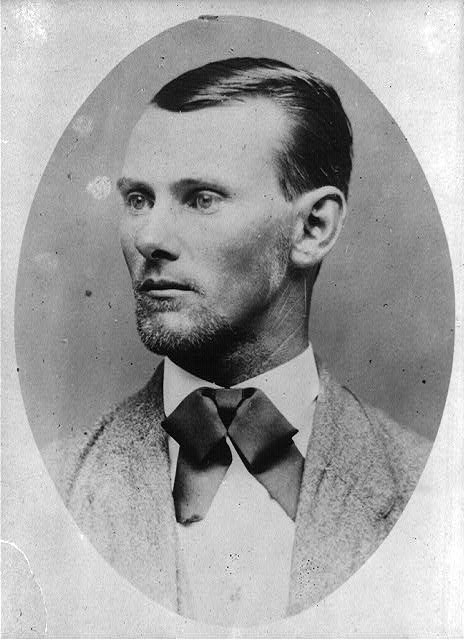
The first bank robbery Jesse likely participated in, though it is unconfirmed, was on February 13, 1866. This robbery was not under the James-Younger Gang banner. Instead, it was a collection of old guerillas following one of their former commanders, Archie Clement. Jesse’s participation is likely but unconfirmed because a witness named the James brothers as participants. However, after receiving threats, he recanted.[10] This group would go on to cause trouble in Missouri with their robberies and messing with local elections. Their run ended with the death of Archie Clement in December of 1866.
A robbery and murder in 1869 is the first robbery in which historians are confident Jesse participated. On December 7, Jesse and Frank walked into Daviess County Savings Association with murder and greed on their minds. They wanted the money from the bank and revenge for a comrade long dead. The robbers had heard that Samuel P. Cox worked at the bank. Cox had killed Jesse’s old commander, “Bloody Bill” Anderson. Jesse was going to kill Cox on site. Fortunately for Cox, he was not working that day. Unfortunately, his substitute, John W. Sheets, was confused for Cox. Jesse saw sheets and shot him. Sheets died for an act he never committed. They knew Jesse was there because witnesses spotted Jesse’s prize racehorse as he fled.[11]
If I were to cover all of Jesse James’s recorded crimes and robberies, it would take a while, and you’d grow bored reading the words. And I’m not good enough at art to draw it for you. Suffice it to say Jesse and his gang were active. At first, they targeted banks, but eventually, they shifted to trains. There was violence, intimidation, and, as always, greed.
So how did Jesse and his compatriots escape the ire of the citizens of Missouri? How did the myth of Jesse James get built as he committed crimes across the state? Jesse may have called himself Robin Hood, but he certainly didn’t rob from the rich to give to the poor. He kept that money. Sometimes, the gang would let average citizens hold onto their belongings during a robbery, but that was no guarantee. The truth is that Jesse James understood something in the 19th century that some modern-day celebrities still struggle to grasp. A good public relations person can make all the difference.
John Newman Edwards (1839-1889) was a Missourian and major in the Confederate Army during the Civil War. He was part of a group of about 1,000 men who refused to accept the Confederate surrender and, as a result, fled to Mexico. Mexico was going through its own period of chaos, and so Edwards returned to Missouri in 1867. He worked for the newspaper Republican for a year before starting his own paper, the Kansas City Times, in 1868. Edwards seemed to have one goal with his writing: to stress the righteousness of the Confederate cause.[12]
When he heard about Jesse James, Edwards must have felt like Jaffar in Aladdin. There was a diamond in the rough, a person he could use to advance his cause. Edwards would write about Jesse and his gang. Edwards would praise them and explain they weren’t criminals. He would explain to the public that they were fighting for a cause and that the police and businesses were wrong for persecuting the gang. It was highly effective. There was even an amnesty bill that almost passed the state legislature in 1875.[13]
This relationship was not one-sided. Jesse saw a chance to clear his name and get his thoughts into the world. He would write letters to the newspaper that Edwards would publish. These letters would range from Jesse declaring his innocence to explaining the righteousness of his cause. Conveniently, Jesse’s letters exposed the exact cause as Edwards. Historian James Muehlberger doubts that Jesse wrote all the letters. Muehlberger believes that Edwards wrote some of the letters when needed.[14] Whatever the case, the articles and letters were effective. They began the Jesse James mythology.
Looking back on things, it almost seems like the authorities, with their ineptitude, wanted to help build the Jesse James mythology. On January 25, 1875, the Pinkerton Detective Agency launched a raid on the James household to capture the brothers. They threw a flammable shell into the house to illuminate it. Unfortunately, those in the house did not know it was flammable when they threw it into the fire. There was an explosion. The explosion killed Jesse’s eight-year-old half-brother, Archie Samuels. Jesse and Frank were not home.[15]
This event was a gold mine for Edwards, who wrote about the evils of the Pinkertons. For Jesse, it likely only made him hate the authorities more. Jesse would have their revenge on those who helped the Pinkertons. On April 12, Jesse would kill Daniel Askew in his backyard. Daniel had helped the Pinkertons locate the house for their raid.[16] It did not pay to cross Jesse James.
The James Younger gang would meet its end in Minnesota. The gang of eight went into the town of Northfield to rob First National Bank, which only held the money of the town’s residents. This robbery was not a very Robin Hood move. It was a disaster from the start. The bank cashier, Heywood, would not cooperate and stall when opening the vault. Once opened, he tried to trap Frank inside the vault. The delay allowed the township residents to notice what was happening. In a scene out of most westerns, the two opened fire on the outlaws. In the shootout, two of the outlaws went down. Clell Miller and Bill Chadwell would die at the hands of the Northfield residents. Frank James killed Heywood out of spite before fleeing the bank. The gang got $26.60.[17]
Fleeing from the bank was not the end of the trouble for the group. They were wanted and hunted men. Frank and Jesse decided to go their own way. The Younger brothers and Charlie Pitts stayed together. The Younger brothers and Pitts made a fatal error of stopping by a house in Madelia for food. The authorities had already warned the area about the fugitives. Residents of the house notified authorities, who quickly came after the outlaws. Once again, the Younger brothers and Pitts found themselves in a shootout. Pitts was killed while the Youngers were badly wounded. All three Younger brothers surrendered.[18] Frank and Jesse made it back to Missouri, but their gang was no more.
Frank and Jesse took separate paths for a bit after the Northfield robbery. Frank embraced domestic life and appeared to thrive, while Jesse continued his criminal ways. He formed a new gang and continued to rob and murder. Eventually, being such a good brother, Jesse decided to pull Frank back into the outlaw life. However, this doesn’t last as Frank eventually flees the gang, having truly outgrown the outlaw lifestyle. The new gang had three new important members: Wood Hite, James Liddil, Charley Ford, and his brother Robert.
The reason is that each of these men would play a role in the downfall of Jesse James. It began with a kitchen table shootout between Wood Hite and James Liddil over a woman. Tensions had been high in the gang because Jesse was now profoundly paranoid. He had turned against one former gang member and killed another out of his paranoia. I would cover Jesse killing the gang member, Ed Miller, in more detail, but it really was just a case of Jesse being paranoid and forcing an argument. We now go back to the kitchen shootout. In the shootout, Liddil was wounded in the thigh, and Hite was killed either by Liddil or Robert Ford, who walked in on the events. Hites’s death might not have been an issue, except he was Jesse’s cousin. Liddil thinks Jesse will kill him in revenge. Stuck between a rock and a hard place, Liddil turns himself into the authorities.[19]
Liddil’s turn led to authorities raiding the gang’s safehouses, forcing them to go further on the run. Liddil was not the only one to turn on Jesse, but this time it was for money. When he saw what was being offered for killing Jesse James, Robert Ford must have had dollar signs in his eyes. Robert went to the authorities, offering to kill Jesse for the reward. He even convinced his brother Charley to help. On November 8, 1881, the two brothers decided to make their move. However, as the famous movie title says, Robert Ford was a coward. He wasn’t going to confront an armed Jesse James. Instead, he and Charley waited for Jesse to put down his weapons. Furthermore, they waited for Jesse to turn his back on them, and they pulled the trigger.[20] Jesse James died not in some glorious shootout but from the bullet of a traitor.
I’m not going to cover what became of Jesse’s former gang members, but I will note that almost all of them tried to make money off their fame. This group includes the Fords and Jesse’s brother, Frank. People were using crime and fame for money even in the 19th century. Impressive.
Jesse James lived such an eventful life that I had to cut many things out to keep this article relatively short (okay, I did my best). I might not even have been able to portray the man entirely. So let me say this: Jesse James only knew violence from the age of 16 till his death. He fought to maintain slavery, and he killed to make money. Jesse formed a working relationship with John Edwards to advance an agenda that didn’t match reality. Jesse was not Robin Hood. He stole from many and gave to none. He was not a righteous outlaw but a criminal who would kill anyone who got in his way. That was Jesse James.
I saved one final detail about Jesse’s life for the end. Jesse James married and had children. His wife was Zerelda Mims, and she was his first cousin. Oh, and if that name seems familiar, Jesse’s wife was named after his mother. Yeah.
[1] T. J. Stiles, Jesse James: Last Rebel of the Civil War (New York, NY: Vintage Books, 2003), 25.
[2] Ibid, 29
[3] Ibid, 34
[4] Ibid, 90-91
[5] Ibid, 104
[6] Ibid, 113
[7] James P. Muehlberger, The Lost Cause: The Trials of Frank and Jesse James (Chicago, UNITED STATES: Westholme Publishing, 2013), 51.
[8] Stiles, 116-17.
[9] Muehlberger, 54.
[10] Stiles, 187-88.
[11] Mark Lee Gardner, Shot All to Hell: Jesse James, the Northfield Raid, and the Wild West’s Greatest Escape (New York, NY: HarperLuxe, 2013), 35.
[12] Stiles, 223-25.
[13] Gardner, 34.
[14] Muehlberger, 72-73.
[15] S. Paul O’Hara, Inventing the Pinkertons; or, Spies, Sleuths, Mercenaries, and Thugs: Being a Story of the Nation’s Most Famous (and Infamous) Detective Agency (Baltimore, MD: Johns Hopkins University Press, 2016), 45.
[16] Gardner, 50.
[17] Ibid, 72-104
[18] Ibid, 152-168
[19] Stiles, 383-85.
[20] Stiles, 384-87.
 Here For History
Leave a comment