**Following up is a series in which I explain interesting things about the topic I chose or why it matters that people know this history. It also provides a review of the books used with links to buy them. It greatly helps the blog if you use these links to purchase any book that interests you. Please see the story being referenced here.
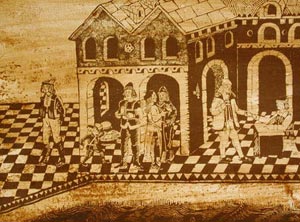
I have an inherent interest in financial and economic history. I tend to focus on banking history when looking at economic history. This interest of mine made the Medici Bank a natural topic to research. The Medici Bank is one of the most famous banking institutions in history. The bank enabled the Medici family to rise to prominence and dominate Italy for generations.
The bank’s relationship to the rise of the Medici family is why it’s an important historical topic. The Medici family perfectly exemplifies how business and politics intertwine. When Giovanni di Bicci opened the branch in Florence, the family was not a serious political entity. When Cosimo leveraged its financial success, the family became influential in the political theater. Cosimo used bank funds to build relationships with the papacy. His steps with the bank would lead to a Medici as Pope. I feel it is safe to say that without the bank’s financial success, there would not have been a Medici Dynasty.
I understand that today’s world has many examples of business people leveraging their success to enter politics. However, I think we must learn the history of this practice. People should understand that this is not an American tradition. It is not even a recent creation. The Medici were not even the first to take advantage of their business enterprises. Understanding the practice’s extensive history will help us move forward when deciding how we regulate business and politics.
Anyone who read my article on the Medici Bank (If you’re reading this, I would think you did) will notice I used historical works as references. I want to go over a bit about a few of those works. The following information will feature a couple of quick thoughts so you know whether or not reading that book is for you. Truthfully, if you’re interested in the topic, I encourage you to read all my sources.
Please Note: As an Amazon Associate I earn from qualifying purchase.
The Medici: Power, Money, and Ambition in the Italian Renaissance by Paul Strathern
I list this book first because it is the book that got me hooked on the topic. Strathern states within the book that he wrote this to be a popular history book. When Strathern says popular, he means for the general population. There are two types of history works: those meant for academics and those meant for the general population. Strathern achieves his goal because this book is an easy read and covers the topic in sufficient detail. It goes beyond the bank to cover the Medici family as a whole. This work is the type of book I would feel comfortable recommending to anyone with an interest in history.
Kindle: https://amzn.to/4aZxeYS Hardcover: https://amzn.to/3S19Y4d Paperback: https://amzn.to/3Hmm2bw Audible: https://amzn.to/47xdxop
The Rise and Decline of the Medici Bank, 1397-1494 by Raymond De Roover
De Roover’s book may be the single most comprehensive work on the Medici Bank. De Roover ignores the other aspects of the Medici and focuses solely on the bank’s history. He extensively uses the bank’s own records to explain the day-to-day business operations. De Roover’s work is vital for someone who wants more than a passing understanding of the Medici Bank. That being said, it is most certainly written for academics, and even in those circles, I think it would be considered a tough read for many. De Roover’s focus on the business can sometimes make a reader feel like they’re reading an accounting book. However, I’d still suggest the book for anyone wanting a deeper understanding of the Medici Bank.
Kindle: https://amzn.to/4b190xJ Hardcover: https://amzn.to/48AC3q0 Paperback: https://amzn.to/4aUAQeT
Medici Money: Banking, Metaphysics, and Art in Fifteenth-Century Florence by Tim Parks
Parks’ work sits in the middle of Strathern and de Roover. It can feel a bit more academic at times than Strathern, but nowhere near the level of de Roover. Like Strathern, this book looks beyond the bank and gets into other areas of the family. Parks explores the relationship between the family and art. This relationship would help the Medici cultivate a reputation they would use to their advantage later. I consider this to be a good read.
Kindle: https://amzn.to/3SkNMDJ Hardcover: https://amzn.to/3tQLm6h Paperback: https://amzn.to/48zcLbY
The House of Medici, Its Rise and Fall by Christopher Hibbert
This book focuses less on the bank and more on the family. This work would be something I’d recommend to anyone looking to put their focus away from the economic histories involving the bank. The history of the Medici family is fascinating, considering their influence and relationship with the papacy.
Kindle: https://amzn.to/3RZGnbl Hardcover: https://amzn.to/3vDrJ29 Paperback: https://amzn.to/48ClyKm Audible: https://amzn.to/3O5J4qR
The Family Medici: The Hidden History of the Medici Dynasty by Mary Hollingworth
Hollingsworth is operating in the same arena as Hibbert with her book. She focuses less on the bank and more on the family’s political operations. Her goal is to remove the romantic portrait of the Medici and describe their history, which often can be darker. Hollingsworth brings the Medici to the level of devious, deceitful people looking to gain and hold power. It definitely makes for an interesting read.
Kindle: https://amzn.to/3tXvkaH Hardcover: https://amzn.to/3O3ekqi Paperback: https://amzn.to/3TXn4lL Audible: https://amzn.to/41YPYDS
Please click the links and buy anything if these books interest you. It would really help out the blog.


 Here For History
Leave a comment