
The American Revolution was not a cheap endeavor, and the Continental Congress often found itself in desperate need of funds. Congress used multiple methods to obtain funds, including loans from France, issuing colonial currency, and eventually taxation.[1] Congress reported that after the war, its debt totaled $8 million to foreign loans and $42 million to domestic debtors.[2] While congress, made up of over 50 men, was implementing their plans and racking up that debt, it’s Robert Morris who is remembered as the Financier of the Revolution.
Money Printing, Taxes, and Loans
The Continental Congress recognized the momentous task in front of them. They knew they’d have to begin forging alliances and securing funding, but first, they needed a leader for their army. They chose George Washington, a Virginian farmer and former Colonel in the Virginia Regiment of the British army. Regardless of true humility or valuable insight, George Washington refused payment for this position and only requested Congress reimburse his expenses after the war.[3] Congress likely was very grateful for this request during their darkest days.
Congress gave Washington the unenviable task of building the army, training it, maintaining it, deploying it, and eventually winning with it. The mission of building, training, and maintaining is where Washington intersects with the financing of the Revolution. George Washington needed funds to buy supplies, pay existing soldiers, recruit new soldiers, and maintain weaponry. Washington could do no more than beg Congress for funds in some of the worst moments of the war.
Almost immediately, Congress realized it was in trouble regarding funding. Initially, taxation was not an option for Congress. Aside from not having the authority to issue a federal tax, the political ramifications of trying the endeavor were not worth it.[4] The inability to levy a tax left Congress with several options to consider: issuance of their own currency, foreign and domestic loans, and, interestingly enough, borrowing the credit of one of its wealthiest members, Robert Morris. Eventually, taxation made its way into the finance plan as it proved impossible to fund the war effort without it.
Creating and distributing their own currency was the favorite method of Congress. In 1775, Congress began to issue the Continental Dollar, which they used to pay for most of their purchases. Economic historian Farley Grubb wrote, “From 1775 through 1779, net new emissions totaled almost $200 million (face value) and accounted for 77 percent of congressional spending.”[5] This is a staggering figure for a relatively easy solution of printing your own money, but it was not without its pitfalls. The Continental Dollar ran into several issues during the years Congress had it in circulation.
The first issue facing the Continental Dollar was devaluation due to counterfeiting. While there were certainly select individuals who would likely have attempted to counterfeit the new currency, the ultimate perpetrator of this crime was the British. “The British were well aware of the importance of finance in conducting warfare and knew that if they could undermine the revenue policy of the Continental Congress, the rebellion would collapse. Therefore, early in the war, the British set out to undermine the value of the Continental dollar by counterfeiting it.”[6]
Counterfeiting is detrimental to a currency because it quickly devalues it. For example, we could look at what would happen to Pennsylvania’s currency if counterfeited. Pennsylvania used gold and silver to back their currency in case of redemption. If they issued 100 dollars supported by 100 pieces of gold, then the value of 1 dollar is one piece of gold. However, if high-quality counterfeits enter the market, vendors will accept them. Now those 100 pieces of gold must cover 200 dollars, meaning counterfeits have cut an individual dollar’s value in half.
As it stood, Congress devalued its own dollar by issuing far more than it could support based on its original redemption requirements. It can be summed up by Farley Grubb “In other words Congress had recklessly emitted excessive amounts of a fiat currency—paper Continental dollars—which caused runaway price inflation (runaway currency depreciation) that destroyed its value and led to its abandonment.”[7] It’s debatable if Congress ever planned on truly having to redeem their currency’s full value or if they knew they would lessen its impact by over-inflating it.
The fact that States also issued currency limited the impact of Continent Dollars. The States and Congress competed for the assets to back the issued currencies. The result was an increased supply of money. The oversupply further devalued the dollars of both Congress and the States.[8]
After currency, the second option to Congress was taking out loans. France has long been considered the primary lender to the American Revolution; however, they did not offer loans until later in the war. Also, as mentioned earlier, foreign loans were far below domestic loan levels. The Continental Congress managed to incur such large domestic debt by forming Continental Loan Offices in the 13 states. Historian Charles Rappleye explains that they began in 1776 by offering five million dollars in certificates bearing 4 percent interest.[9] The effort struggled at first due to competition from state treasuries, but a new rate of 6% helped Congress be more competitive.
The problem with loans, of course, is interest payments. By the war’s end, Congress estimated that the yearly interest payment on these loans was $2.5 million.[10] This large sum means that not only were loans difficult to obtain they were the most costly method of financing. Repaying a debt of $2.5 million was not easy for a poor Congress. Between competition and interest concerns, loans had their limitations.
However, that did not stop Congress from reaching out to France for help. Of the $8 million in foreign loans, Congress owed $7 million to France. This figure does not include France’s $2 million gift to the Continental Congress. The advantage of borrowing from France was that Congress did not have to begin repayment of the loan until 1786. France also seemed unconcerned about repayment, considering the original repayment date in 1786 passed with Congress sending no payment and France lodging no complaint.[11]
The real issue with borrowing from France was France’s willingness. France had little interest in sending funds to the Continental Congress early in the conflict. This feeling could be attributed to France believing that the Continental Army stood little chance of victory. France changed its attitude toward the Continental Army after the Battle of Saratoga. Per Ben Baack:
“With the defeat of the British at Saratoga, Congress saw an opportunity to convince the French that the Americans had a reasonable chance of success in the war. Within a month it approved the Articles of Confederation with the hope that this action, coupled with the victory at Saratoga, would persuade the French to recognize and assist American independence.”[12]
It is important to note that even with the change in attitude, France still was slow to provide support. It is also important to mention that their military support was their larger contribution. People should not overlook the financial aspect of France’s aid, but when historians consider the entire cost of the war, they made up only a small portion of the funding. Their supply of men, troops, and ships was their real contribution.
Struggling for options in 1777, Congress decided it was finally time to initiate a federal tax. Initially, the tax was voluntary. Congress listed what each state needed to contribute, but it was up to the state to decide if they wanted to pay the amount. Congress would publish the state contribution in an effort to shame those not paying. Quickly realizing they needed to do more, Congress required states to seize property belonging to loyalists. States would sell the property, and have the proceeds sent to Congress. Congress still felt they needed more from the states. Finally, in March of 1781, Congress passed the Articles of Confederation, which allowed for tariffs on imported goods.[13] Tariffs would be the closest mandatory tax Congress ratified.
Congress would still experience shortfalls even with these sources in place. Furthermore, issuing currency, loans, and taxes takes time, and the army needed funding immediately. How, then, could Congress obtain goods for the army while they waited for their funding sources to come through? What other options did Congress have available?
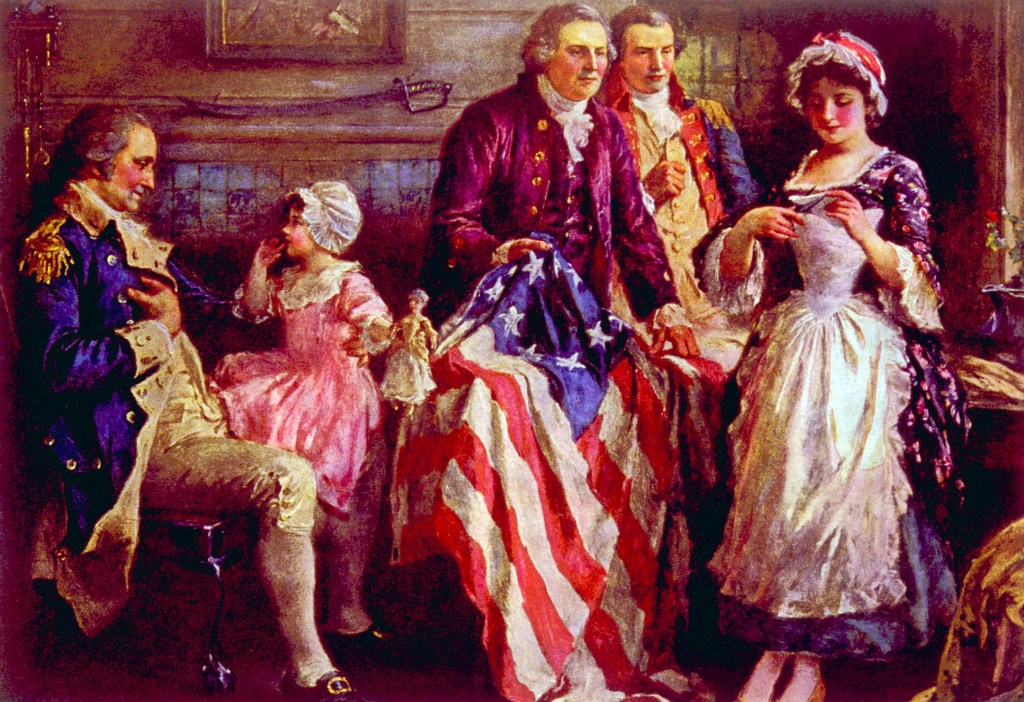
General George Washington, Major George Ross, Robert Morris, Betsy Ross with the first American flag, approved by Congress on June 14, 1777. Everett Collection/ Shutterstock
Just Call Him The Financier
Robert Morris was 42 when he signed his name on the Declaration of Independence. He was attending the Second Continental Congress as a representative from Pennsylvania. Morris was selected not only because he had turned into an ardent patriot but also because he was possibly the wealthiest man in the colonies. Morris had grown his wealth through an exceptionally profitable shipping firm.
Being the most successful businessman dealing in imports made Morris the unofficial head of finance from the start. He was placed on all committees relating to finance and purchasing. He would go on to earn titles newly created by Congress for him. Morris was able to achieve what will be described in the following paragraphs due to his position of power within Congress.
Robert Morris understood early on that Congress did not have the financial strength necessary to purchase the goods and supplies needed for the war effort. Morris provided the means to buy these goods in two ways. The first way was to use his personal credit as the guarantee for the loans. As Ray Raphael put it: “Merchants who refused to deal with a floundering Congress were willing to do business with “The Financier,” as he was called both at home and abroad. They would not accept Continental currency, but they would take “Morris Notes,” which were treasury bills backed by his own personal credit. If the government could not pay, Morris himself promised he would.”[14] Morris put his personal wealth on the line to guarantee payments on shipments.
Morris took an extreme risk by placing his wealth on the back of Congress’s ability to pay. It was far from certain that the Continental Army could win the war, and if they lost, then there would be no Congress from which to pay merchants. Furthermore, even in victory, the financial condition of the new country would be shaky. There was the genuine possibility that Congress would be unable to pay the merchants, and Morris would have to fill in as guarantor. The risk to his fortune was high.
Compounding the risk to his fortune was the fact that Morris often fronted the money necessary to purchase supplies. He would then request reimbursement from Congress. Morris was willing to do this in the direst of times for the army. Responding to a letter written by George Washington in December of 1776 requesting aid, Morris paid merchants and suppliers whatever was necessary.[15] He followed this up by finding an additional $50,000 in January, which he forwarded to Washington to help pay his soldiers.[16] He paid this money while sitting in the former capital now occupied by the British.
Morris would attempt to bring in other business leaders to help fund the war efforts. A letter written by Philip Schuyler to George Washington on June 18, 1780, describes Morris creating an association with the purpose of furnishing the army with rations. However, Schuyler does note that while the association is fronting the costs, they expected reimbursement eventually.[17] This letter shows the efforts Morris was going through to collect funds.
Morris was able to be so directly involved with the purchasing of supplies because he was on the Secret Committee. The Secret Committee was composed of several congressional members whose job was to purchase war material. It was usually through a series of agents and contractors on behalf of the Continental Congress.[18] The need for a secret committee was to facilitate easier and quicker purchases. Morris took advantage of the committee, and his shipping company was often the selected contractor.
While operating as a member of the Secret Committee, Morris set his eyes on reimagining the American financing system. Robert Morris proposed to Congress the Bank of Pennsylvania. The Bank of Pennsylvania would not operate as a traditional bank but rather as a public depositor wherein private funds could be deposited. The bank would then provide bills to be distributed. These bills would maintain value based on the merchants’ confidence in accepting them.[19] The bank officially opened in July 1777. The bank was a great success, with Washington reporting in August that the bank was his principal source of supplies.[20]
Morris’s contributions to the American cause were great enough that in 1781 Congress voted him in as the first and only Superintendent of Finance of the United States. In this position, Morris oversaw all the Continental Congress’s financial decisions. His responsibility for purchasing war materials did not lessen with this additional title. The title effectively placed Robert in control of all financial decisions, loans, purchases, etc., for the entire United States.
With the title of Superintendent, Morris completed his final great contribution to the American financial cause. He created the Bank of North America. The Bank of North America was opened in 1782 and was the first commercially chartered bank in the United States. Of course, the impact of this bank would be felt more after the war’s end, but it did prove to be quite valuable for obtaining funds during wartime.
Robert Morris was the right man in the right spot at the right time. Through his massive wealth and years of experience, he was able to fill the role of financier. Morris provided personal guarantees on international shipments when merchants would not trust the guarantee of Congress. In addition, he used his personal funds to front costs on purchases of supplies. When George Washington was at his lowest, he reached out to Morris for help. Aside from the real contribution wherein he risked his personal wealth, Morris helped the government obtain supplies through the Secret Committee. Morris also set up the Bank of Pennsylvania, which proved to be one of the most valuable ventures for supplying the war effort. Finally, he chartered the first American bank, an event that would impact war efforts and have long-lasting ramifications for the country.
[1] Ben Baack, “Forging a Nation State: The Continental Congress and the Financing of the War of American Independence,” The Economic History Review 54, no. 4 (2001): 639-50, http://www.jstor.org/stable/3091625.
[2] Ibid, 650
[3] “Address to the Continental Congress, 16 June 1775,” Founders Online, National Archives, https://founders.archives.gov/documents/Washington/03-01-02-0001. [Original source: The Papers of George Washington, Revolutionary War Series, vol. 1, 16 June 1775 – 15 September 1775, ed. Philander D. Chase. Charlottesville: University Press of Virginia, 1985, pp. 1–3.]
[4] Jacob William Schuckers, A Brief Account of the Finances and Paper Money of the Revolutionary War (Philadelphia: J. Campbell & Son, 1874, 1874), 9. https://link-gale-com.ezproxy.liberty.edu/apps/doc/CY0108184440/SABN?u=vic_liberty&sid=bookmark-SABN&xid=09820a74&pg=12.
[5] Farley Grubb, “State Redemption of the Continental Dollar, 1779–90,” The William and Mary Quarterly 69, no. 1 (2012): 147, https://dx.doi.org/10.5309/willmaryquar.69.1.0147.
[6] Baack 643.
[7] Grubb 149-50.
[8] Baack 642.
[9] Charles Rappleye, Robert Morris: Financier of the American Revolution (New York: Simon & Schuster, 2010), 109.
[10] Baack 650.
[11] Allan Potofsky, “The Political Economy of the French-American Debt Debate: The Ideological Uses of Atlantic Commerce, 1787 to 1800,” The William and Mary Quarterly 63, no. 3 (2006): 491, http://www.jstor.org/stable/3877373.
[12] Baack 645.
[13] Ibid, 49
[14] Ray Raphael, “The Financier: Robert Morris, America’s Original Bailout Czar,” Financial History (2009), 1
[15] Rappleye, 27.
[16]Letters of Delegates to Congress, Smith, Paul H., et al., eds. Letters of Delegates to Congress, 1774-1789. 25 volumes, Washington, D.C.: Library of Congress, 1976-2000).
[17] Ibid
[18] Elizabeth Miles Nuxoll, “Congress and the Munitions Merchants: The Secret Committee of Trade During the American Revolution, 1775-1777” (Ph.D., City University of New York, 1979), iv, ProQuest Dissertations & Theses Global, https://go.openathens.net/redirector/liberty.edu?url=https://www.proquest.com/dissertations-theses/congress-munitions-merchants-secret-committee/docview/302918143/se-2?accountid=12085.
[19] Rappleye, 217.
[20] Ibid, 218
 Here For History
Leave a comment